


Colonial America: Jamestown vs. Plymouth | 5-Minute Videos | PragerU
One was founded on profit. The other on faith. Jamestown and Plymouth shaped two powerful forces in American life: commerce and religion. Thomas Kidd, author of American History Volumes 1 and 2, tells the story of the colonies that helped set the stage for the nation to come.
Watch our content ad-free on our app: https://prageru.onelink.me/3bas/vgyxvm79
Donate to PragerU: https://l.prageru.com/4jiAT85
Follow PragerU:
Instagram ➡️ (https://www.instagram.com/prageru/)
X ➡️ (https://twitter.com/prageru)
Facebook ➡️ (https://www.facebook.com/prageru/)
TikTok ➡️ (https://www.tiktok.com/@prageru)
Transcript:
Colonial America: Jamestown vs. Plymouth
Presented by Thomas Kidd
What would make a seventeenth-century European leave the relative comfort and safety of the Old World for a perilous life in the New?
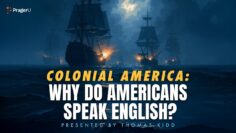
This “New World” wasn’t just new, it was utterly unknown. Getting there was incredibly dangerous. Imagine taking an ocean voyage on a small wooden ship equipped only with sails and simple navigational tools.
And once you arrived — if you arrived — then what? How would you survive? What would you eat? Were the natives friendly or hostile?
These are only a few of the daunting challenges and questions that faced the first American colonists.
Their motivations for coming were complex. But for our purposes, we can put them into two broad categories: financial and religious.
The financial was represented by the settlement at Jamestown, Virginia, established in 1607.
The religious was represented by the settlement at Plymouth, Massachusetts, established in 1620.
By comparing these two colonies, we can learn much about the origins of America.
The colonists who established Jamestown in 1607 were sponsored by the Virginia Company of London, a profit-making venture. 104 intrepid souls made up the first group. There was not a single woman among them, suggesting they had little intention of settling down, but hoped to make some easy money and return home to England as wealthy men.
That hope was based on the naïve belief that gold would be so abundant in the New World that they could just pick it up off the ground. Though they experienced many natural wonders, precious metals were not among them.
Their disappointment was compounded by the unfortunate fact that they built Jamestown near marshes — prime incubators for disease-bearing mosquitos. Just three years after that first ship landed, 440 of the first 500 colonists were dead.
The survivors tried selling timber for export and even experimented with making wine. But nothing seemed to catch on until 1614 when they began cultivating tobacco, already a popular consumer product in Europe. By 1617, a visitor to Virginia observed that the small colony’s “streets and all other spare places [are] planted with tobacco…”
Harvesting the broad, brown-leafed plant was labor intensive. As the century progressed, the Virginians came to rely more and more on slave labor, already being utilized on English sugar plantations in the Caribbean.
The Jamestown colonists were Christians, and one of the first things they did was set up a church — the earliest Protestant church in North America — but faith did not fuel the colonists’ ambition. Profit did.
By contrast, the Plymouth colonists came seeking religious freedom. They were “Separatist” Christians, meaning they believed that the Church of England, the nation’s official denomination, had become fatally corrupt. True Christians, they believed, should “separate” from the national church and form their own congregations. But doing this was illegal in the British Isles.
…access the full transcript here 👉 https://l.prageru.com/3WHs523
source


Thomas Kidd, what about the Speedwell? What about the non-Puritans on the Mayflower that WERE sponsored? What about their destination of the Virginia colony and how they accidentally arrived in the Massachusetts colony? Or how intolerant the Puritans were of other faiths and denominations?
That's my family history. Some of my family ancestors came over on the Mayflower and signed the Mayflower compact. I couldn't be more proud of their courage and perseverance.
The First Thanskisiving was at Berkeley Hundred, Virginia Colony, in 1619.
I love the fact that they actually had turkey at the first Thanksgiving, and here we are about 400 years later, still doing the same thing. Turkey is good, but I can't imagine having eel, shellfish, and cornmeal mush. 😆
Proud to say I am descended from both Plymouth (1623 arrival) and Jamestown (1608 arrival)!
It's also worth noting that they attempted a Collectivist economy in the early years. Communal farming bred laziness and resentment and long-term famine. After about 3 years of communal farming, William Bradford instituted private property protections, and immediately the colonists became industrious.
I love the idea that they may have had lobster at the first Thanksgiving.
FREEDOM🥳🤠
Virginia actually had a Thanksgiving prior to the one in Plymouth. It occurred in Berkeley, on the James River in Virginia, one year prior to the Pilgrims' Harvest Festival meal with the Wampanoags.
You should study Governor William Leete he’s our founding grandfather. He was British royalty and he’s the most unsung hero in American history. He founded this country and let other people take credit for it because of his royal background.
CHECK HILLSDALE UNIVERSITY – COLONIAL AMERICA TRAILER VIDEO 🇺🇸✝️💪🏻
Dark history
Sorry? The richest?
Less than half of the Plymoth colonists were separatists seeking religious freedom.
Too religiously tolerant.
Why oh why did you omit that Plymouth was at first Socialist and suffered the death and misery Socialism always brings. Thanksgiving celebrates their abandonment of Socialism with the resulting bounty prosperous enough to have plenty to share with the Indians.
2:35 – Sadly, chattle slavery came to exist in Jamestown because of the actions of their governor, whom, to the horror of the colonists was exploiting free labor and disrupting the free market. Before that time, indentured servants would fill labor rolls, with the promise of an end to their unpaid labor.
I know this video will be pummeled by history enthusiasts, so I hope I don't get missed. But the "First Thanksgiving" was actually at the Berkley Plantation in Virginia about a year earlier. Another interesting note made by some is that the "Great Awakening" that occurred throughout the colonies in the 1730's and 1740's was more widely received in the southern colonies than the northern. Whereas Virginia was founded to pursue trade and wealth, it was the southern colonies that responded most favorably to Whitefield, Edwards, Spurgeon, and Wesley. A hundred years after they all began they were entirely different.
4:42 – The venison was brought by the natives, and was probably the greatest thing that solidified relations between the two groups. In Europe, eating venison meant that you were either high nobility, or that you were poaching on the King's land. It was completely out or reach for the common man in Europe, which made it literally a royal gift.
Correction… It’s not the “American colonies”; it’s the British colonies. No one called colonies the British established in India and throughout Africa the “Indian colonies” or “African colonies”. So, why call the British established colonies in the Americas “American colonies”? From what I understand, only the US keeps teaching this…not Britain. At the time, “America” referred to the continent. America as a country wasn’t established until 1776; when the British colonialist revolted against Britain to create their own sovereign nation by uniting the 13 colonies into 13 states called “The United States”.